August 03, 2026
← Journal


July 29, 2026
Qué hace diferente al denim japonés
Del denim japonés se habla como si fuera una etiqueta de lujo, y eso es justo lo que se le escapa a la mayoría. No es una categoría de marketing. Es un conjunto de decisiones de producción que casi toda la industria abandonó en los años sesenta porque eran lentas y caras, y que un puñado de hilanderas japonesas mantuvo de todos modos.
Esto es lo que realmente cambia.
Los telares
Hoy la mayor parte del denim se teje en telares de proyectil o de chorro de aire. Son rápidos, son anchos y producen un tejido plano y uniforme. Esa uniformidad es precisamente el objetivo: abarata el corte y facilita la confección.
Las fábricas japonesas siguieron usando en gran medida telares de lanzadera, muchos de ellos máquinas estadounidenses compradas de segunda mano cuando las hilanderas de EE. UU. se modernizaron. Los telares de lanzadera tejen despacio y producen una pieza de tela más estrecha, de unos 80 cm frente a 150 cm o más. Es una desventaja económica evidente: menos tela por hora y más desperdicio al cortar.
Lo que se obtiene a cambio es un tejido irregular. La lanzadera introduce pequeñas variaciones de tensión a lo largo de la tela, y por eso el denim japonés tiene una textura visible en lugar de una superficie uniforme. Esa textura es la que se desgasta de forma desigual, y el desgaste desigual es todo el atractivo.
Una nota sobre el algodón
Un malentendido habitual: en Japón apenas se cultiva algodón. La fibra en bruto se importa, normalmente de Estados Unidos, Zimbabue o Australia. Lo que hace japonés al denim es el proceso: el hilado, el tejido y el teñido, concentrados en su mayoría en la prefectura de Okayama y en Kojima en particular.
Las fábricas japonesas tienden a hilar con más slub —irregularidades deliberadas de grosor a lo largo del hilo— en lugar de buscar la uniformidad. El hilo con slub crea puntos altos y bajos en el tejido. El índigo se asienta de forma distinta en cada uno. Con los meses de uso, los puntos altos se desgastan primero y los bajos conservan el color: así es como unos vaqueros desarrollan contraste en vez de decolorarse de forma plana hasta quedar azul pálido.
El tinte
El índigo no penetra en el algodón. Se deposita por fuera del hilo en capas, envolviendo un núcleo blanco. Esto se llama teñido en anillo y es el mecanismo detrás de cualquier desgaste que hayas visto: la abrasión elimina las capas exteriores y deja al descubierto el centro claro.
El teñido en cuerda, habitual en la producción japonesa, retuerce el hilo formando una cuerda antes de sumergirlo repetidamente en índigo. Más baños, capas más profundas y un contraste más marcado cuando se desgasta. Algunas fábricas usan además índigo natural en lugar de sintético, lo que desplaza el color hacia un azul más verdoso y produce un desgaste más cálido.
Cómo saber qué estás comprando
Si una marca dice denim japonés, la pregunta justa es: ¿de qué fábrica? Kaihara, Kurabo, Nihon Menpu y Collect son los nombres que suenan. Una marca que lo compra de verdad lo sabe, porque es la mayor parte de lo que está pagando.
Mira también el orillo. Dale la vuelta a los vaqueros y fíjate en el borde de la costura exterior: el denim de telar de lanzadera tiene un borde acabado, normalmente con una línea de color tejida en él. Sin orillo no hay telar de lanzadera.
Qué significa al llevarlos
Unos vaqueros de denim japonés empiezan más rígidos de lo que esperas y el primer mes no parecen gran cosa. Luego empiezan a registrar cosas: dónde llevas el móvil, cómo te sientas, cómo doblas el bajo. Eso se vuelve permanente.
Ese es el trato. Compras una prenda que se ve peor antes de verse mejor, y que acaba siendo específica de ti y no de la fábrica.
¿Merece la pena?
Sinceramente: solo si vas a llevarlos mucho y sin miramientos. El denim japonés premia el uso. Si te pones unos vaqueros cuatro veces al año, estás pagando por una característica del tejido cuyo desarrollo nunca llegarás a ver.
Si llevas los mismos vaqueros casi todas las semanas, es una de las pocas compras en ropa que realmente mejora con los años.
Dónde nos situamos
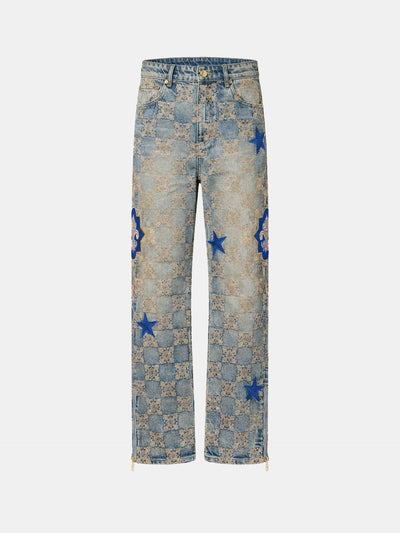
Nuestro 1.618 Monogram Denim es denim de algodón pesado de primera calidad con un monograma bordado con más de un millón de puntadas. Las zonas bordadas se desgastan de forma distinta al tejido plano, así que el patrón gana profundidad a medida que la tela se decolora, en lugar de quedarse en la superficie. No hay dos pares que acaben iguales.
Written by Jaffary Studios